How to organise a football match your friends actually show up to
A practical routine for your weekly football match, from choosing the headcount and filling places to fair teams and settling the pitch bill.
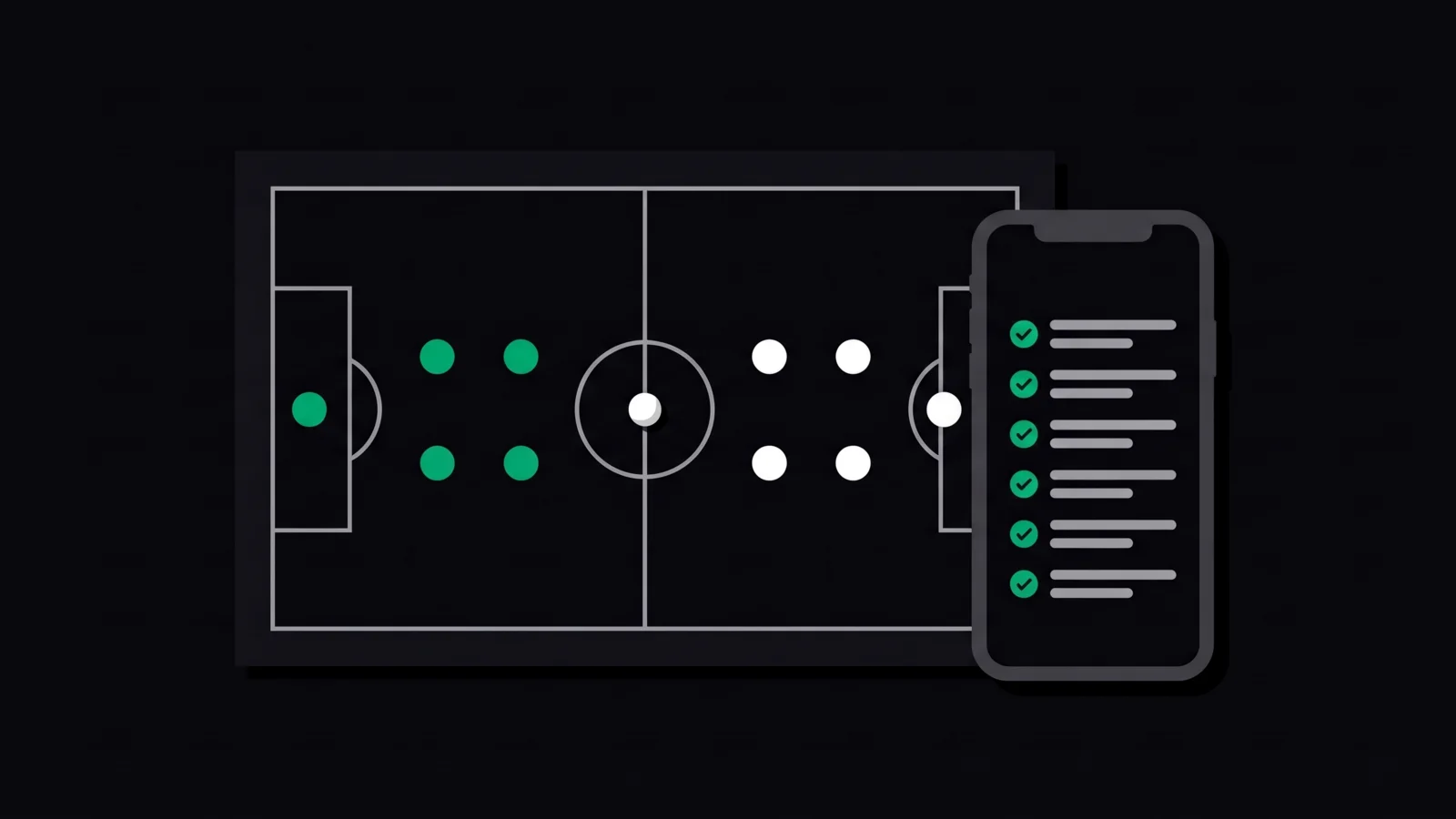
Fill your weekly football match, balance the teams and settle the bill with one repeatable routine.
I organise a Friday indoor football group. The football is the reason we meet, but the work around it used to take over: asking who was playing, answering whether there were places left, chasing payments and trying to build fair teams in my head.
You probably recognise the situation. A few people reply straight away, someone says they might come, and another person answers an old message. By Thursday you have plenty of conversation but no dependable headcount. Then a player drops out and you have to decide whether to chase a replacement, change the format or accept an uneven game.
Learning how to organise a football match starts with separating those decisions, rather than sending more reminders.
Give every player one clear way to join, withdraw and pay.
Fill → Balance → Settle
Fill means a confirmed place, not a hopeful reply. Balance means two playable sides. Settle means nobody has to reconstruct the bill next week.
1. Decide the format and headcount
Start the Fill stage by choosing how many people will actually play at once. Count goalkeepers inside each side, not as extra players you hope to find later.
These are planning examples, not official pitch dimensions or competition rules. The ideal column assumes one substitute per side and regular rotations; if everyone wants uninterrupted minutes, use the minimum instead.
Player numbers by format
| Format | Minimum for equal sides | Ideal with substitutes | Pitch to ask for |
|---|---|---|---|
| 5v5 | 10 | 12 | Dedicated five-a-side pitch or indoor court |
| 6v6 | 12 | 14 | Small-sided pitch approved for six per side |
| 7v7 | 14 | 16 | Seven-a-side pitch |
| 8v8 | 16 | 18 | Larger small-sided pitch approved for eight |
Ask the venue which marked area fits your format. Don’t assume a five-a-side booking can accommodate sixteen people simply because you can squeeze them through the gate.
Write the playing time and substitution plan beside the capacity. Twelve players for 5v5 is a different promise from twelve for 6v6. For a mixed-fitness group, agree short rotations before anyone pays.
Choose capacity from the football you want to play, not the size of the chat.
2. Book the pitch and lock the slot
A booking turns the Fill stage into a specific invitation. Players need a location, start time, duration and expected price before they can commit.
Ask the venue about payment, cancellation deadlines, footwear, access and what equipment is included. Get the confirmation in writing and keep it somewhere a backup organiser can reach. A familiar venue still needs a confirmed booking each time unless you have a standing arrangement.
Here is an example booking note you can adapt:
Friday, 19:00–20:00. Arrive at 18:45. Indoor court, entrance beside reception. Twelve places, rotating substitutes. Total hire 240 zł, expected share 20 zł with twelve paying players. Bring indoor shoes and water. Booking and cancellation contact: the organiser.
Replace every detail with your actual booking, including the venue’s cancellation deadline. Make the arrival time visibly different from kick-off, otherwise your first ten paid minutes can disappear into changing shoes.
A recurring slot removes a weekly date negotiation. If you cannot get one, settle the date first, then open sign-ups for that match only.
Publish one confirmed booking, not a menu of possible evenings.
3. Collect sign-ups without the group-chat poll
A sign-up list records commitments; a chat mixes commitments with conversation. During Fill, separate them so a joke or a question cannot change your headcount.
This fictional exchange illustrates the problem, rather than quoting anyone from my group:
Organiser: Who’s playing Friday?
Player A: Me, probably.
Player B: Is that this Friday or next Friday?
Player C: I can bring someone.
Organiser: Does that mean two confirmed places?
Replace that exchange with one instruction attached to the booking:
Join through the match link if you can attend. The confirmed list is the squad. If it is full, join the waitlist. Remove yourself as soon as your plans change.
Keep the chat for questions and directions. If a friend cannot use the link, nominate someone to record their place and withdrawal; don’t maintain an invisible second squad in private messages.
In SpinMyTeam, I use a group and invitations so players can join the match themselves, with capacity and a waitlist in the same place.
Count the confirmed list once, rather than interpreting every reply twice.
4. Keep a waitlist and expect drop-outs
A waitlist keeps Fill working after the match reaches capacity. It gives the next available person a fair route into the squad without promising more playing time than you have.
Explain the difference between being confirmed and being on standby. A reserve should know whether to travel; the organiser should know whether a newly available place has actually been accepted.
Use a simple replacement sequence:
- The withdrawing player releases their place immediately
- The next reserve gets the opportunity to play
- The organiser checks the updated squad before the confirmation deadline
- Near kick-off, the organiser directly confirms that the replacement can arrive
SpinMyTeam automatically promotes the next waitlisted player when a place opens. That changes the list; it cannot guarantee the person has seen the change or can reach the venue at short notice.
Set a confirmation checkpoint, for example 24 hours before kick-off, and explain what happens if you are still short. Agree a smaller format with the venue or cancel within its terms rather than surprising the players at the gate.
For a firmer routine, read about handling football no-shows.
A reserve list is useful only when everyone knows whether they should turn up.
5. Draw fair teams before kick-off
Balance starts once you have a credible squad. Splitting names evenly is only the first step; one side with both willing goalkeepers and all the strongest defenders will still feel wrong.
Ask who will keep goal, then consider current ability and fitness using the same criteria for everyone. Avoid treating a player’s reputation from years ago as a permanent rating.
Before sharing the sides, make this small check:
Team check before sharing the sides
| Question | Fix before playing |
|---|---|
| Does each side have a goalkeeper plan? | Assign keepers or agree equal rotations |
| Are the strongest players concentrated? | Exchange players of comparable roles |
| Are substitutes shared fairly? | Set a rotation order for both sides |
Tell players the teams are a starting point. If the game is clearly uneven, agree a change at a break instead of making someone the public explanation for the score.
The worked example in drawing fair teams shows how to use ratings without turning the evening into a selection trial.
Balance the jobs each side needs, then check the overall ability.
6. Use a match-day checklist
Match day joins Fill to Balance. The aim is to check the few things that can stop play, not spend the warm-up administering the group.
Give a backup organiser access to the booking details. If you are late, the match should still start. Use this checklist before people leave home and again at the venue:
- Check the confirmed squad and any last-minute replacement
- Share the entrance, arrival time and any access change
- Confirm who is bringing the ball, pump and bibs
- Check the venue’s footwear requirements and changing arrangements
- Agree goalkeepers, teams and substitute rotations
- Locate first-aid help and make sure everyone knows who to contact
- Record who actually played for the settlement
For example, the booking note might say that one named person brings bibs and another brings the ball. “Someone usually brings them” is not an assignment.
Keep local rules short: how you restart, whether there are restrictions around the goal area and how you handle substitutions. Explain them to newcomers before the first disputed challenge.
Make the match runnable even when the usual organiser arrives last.
7. Settle the pitch cost the same evening
Settle begins with the agreed cost rule, not with whoever happens to answer a payment message. Decide before sign-ups whether a late withdrawal still owes a share when no replacement comes.
Here is a worked example, not a report of a particular match:
Worked example of a 240 zł booking
| Situation | Calculation | Amount per paying player |
|---|---|---|
| Twelve paying players | 240 zł ÷ 12 | 20 zł |
| Eleven paying players | 240 zł ÷ 11 | About 21.82 zł |
| Eleven attend, absent player still owes | 240 zł ÷ 12 | 20 zł |
If you split between eleven, handle the rounding explicitly: ten payments of 21.82 zł and one of 21.80 zł total 240 zł. Don’t quietly leave the organiser paying the difference.
Record the venue cost, any agreed extras and each person’s amount while attendance is fresh. Mark a payment when you receive it, not when someone says they will send it.
For withdrawals, credits and unpaid balances, use the examples in splitting pitch costs.
Close the bill against the rule everyone accepted before playing.
Organising a football match without the chaos
Fill → Balance → Settle is a routine you can repeat without rewriting the rules every Friday:
- First, publish one booking with capacity, a sign-up route and a withdrawal rule
- Skip parallel lists in chat, private messages and your memory
- Measure confirmed arrivals and unpaid shares after each match
Which part of your weekly match still needs the most chasing: filling places, balancing teams or settling up?