How to split players into fair teams for 5-a-side
Use one rating scale, account for goalkeepers and try a worked snake draft to split ten players into fair five-a-side teams.
Author
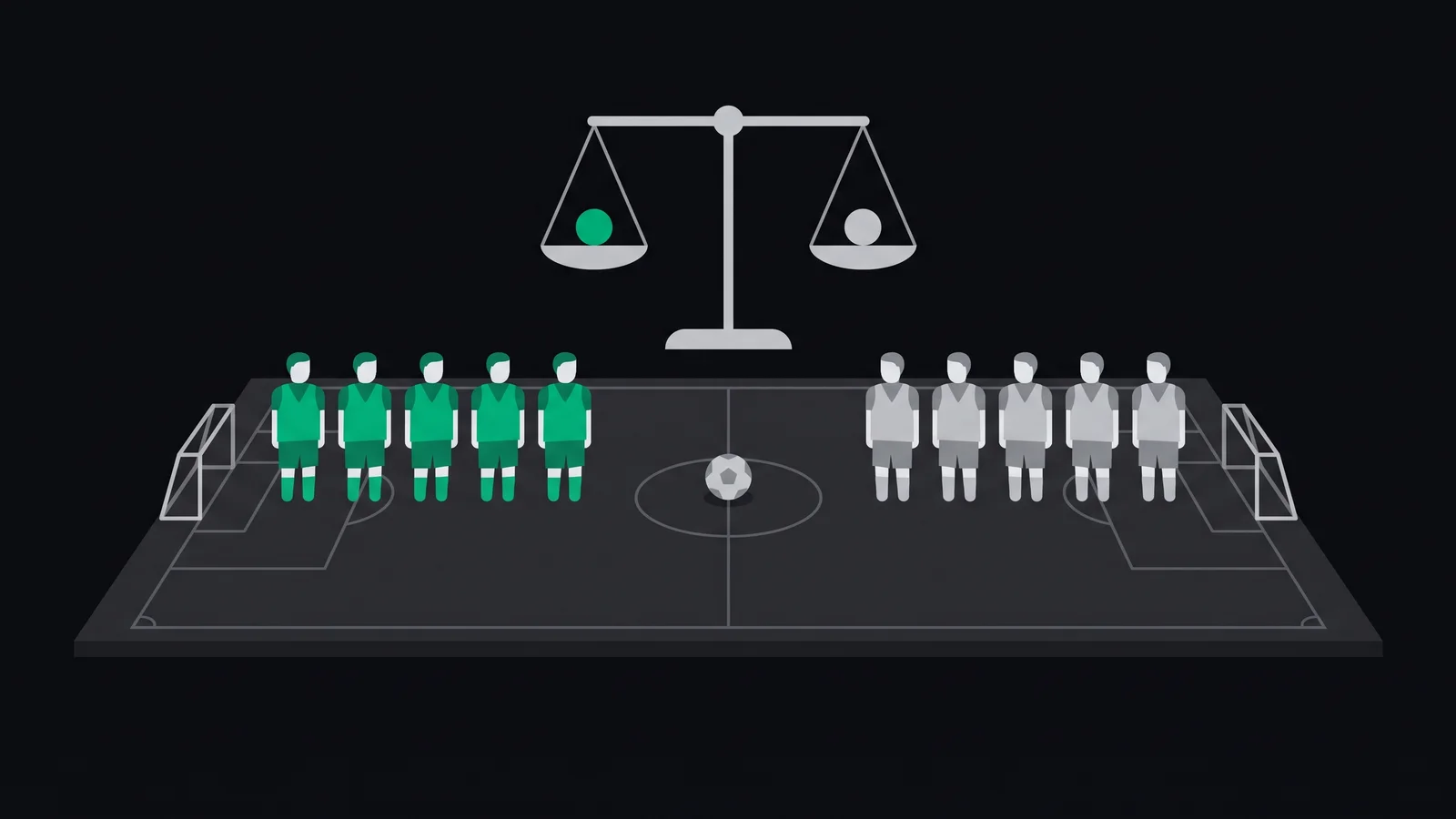
Split ten players into two competitive sides using a shared rating scale, a role check and a repeatable draw.
I organise a Friday indoor football group. Before building SpinMyTeam, I worked out the teams in my head alongside chasing sign-ups and payments. Complaints about unfair teams were part of the same routine. Having enough players didn’t mean the organising was finished.
You can probably picture the problem. Ten people have arrived, someone hands out bibs, and the strongest pair ends up together. One side has both willing goalkeepers. You suggest a swap, somebody objects, and the booking clock keeps running. Even if the eventual score is close, nobody can explain why those particular teams were chosen.
I want a method I can explain before anyone knows which side they’ll be on. It doesn’t need to predict the result.
Fair teams need an agreed process, not an organiser who wins every argument.
Rate → Constrain → Draw
Rate everyone on the same scale. Constrain the split around real playing needs. Draw the teams only after those checks.
1. Replace captain picks with a shared method
Captains choosing alternately is familiar, but it mixes ability, friendship and reputation. The first pick matters, and the last person selected gets an unnecessary public judgement.
The Rate step separates that judgement from the moment people want to start playing. Agree the method in the group beforehand. You can still have captains for kick-off and keeping substitutions organised; they don’t need to negotiate the squads.
Here’s a proposed group message, not a quote from a player:
We’ll use the same ability scale for everyone, separate the regular keepers, then split the remaining players. If something looks wrong, explain the role that’s missing rather than asking for your favourite teammate.
If you’re still deciding the headcount, use the match planning guide first. A balanced ten-player draw won’t solve an eleven-player rotation you haven’t agreed.
Don’t promise that this removes every complaint. It gives you a concrete question to answer when somebody objects: was the rating wrong, was a role missing, or did the game simply go badly?
Agree how teams are made before discussing who belongs together.
2. Rate players on one five-point scale
Use a simple overall rating for your group, not separate scores for every touch. Rate typical contribution across several sessions, including defending and passing, rather than remembering the best goal.
This suggested scale is a starting point, not a validated sporting assessment:
| Rating | What you usually see |
|---|---|
| 1 | Learning positioning and control, needs time on the ball |
| 2 | Makes basic passes, contributes with support nearby |
| 3 | Reliable in ordinary play, helps in attack and defence |
| 4 | Handles pressure well, regularly creates or prevents chances |
| 5 | Consistently shapes the game against this group’s strongest players |
Rate means using the same reference point. A five in your casual group isn’t a claim about league football. Don’t increase a friend’s score because they played competitively years ago if their current contribution is different.
Give a newcomer a provisional rating after asking about recent experience. Explain that you’ll revisit it after seeing them play. Avoid presenting a guess as a permanent label.
Keep availability separate. A reliable attendee isn’t necessarily a stronger player, and a missed match shouldn’t lower their ability score. The guide to no-shows handles that different problem.
Rate what players usually contribute now, using one scale for everyone.
3. Balance positions before comparing totals
Constrain means deciding what each side needs before you accept a numerical balance. In five-a-side, goalkeeper arrangements deserve the first check. Two willing keepers on one team can outweigh a tidy-looking total.
Ask who wants to keep goal and whether anyone needs shorter spells outfield. You don’t need a medical explanation. You need enough information to plan participation without expecting someone to do something they can’t.
Use this role check before the draw:
- Put one regular goalkeeper on each side when two are available
- If nobody wants a full game in goal, agree equal rotations
- Check each side has someone comfortable defending and starting attacks
- Account for known playing restrictions without publishing personal details
These are manual organising decisions, not a claim that any team generator understands positions automatically. Keep the constraints few and relevant. Requiring every pair of friends to stay together leaves little room to balance anything.
For example, if the two keepers have different ratings, separate them first and compare the totals after distributing the outfield players. The snake draft below assumes both teams will rotate goalkeeping, so no keeper has to be fixed in advance.
A matching total is useful only when both sides can actually play.
4. Try a snake draft with ten players
Draw starts with the rated list, strongest first. Assign players in the repeating order A, B, B, A. This reverses the order after each pair of picks instead of giving Team A every odd-numbered player.
Here’s an invented example with ten players and shared goalkeeping duties. Names and ratings illustrate the arithmetic; they aren’t results from my group.
| Rank | Player | Rating | Team |
|---|---|---|---|
| 1 | Adam | 5 | A |
| 2 | Ben | 5 | B |
| 3 | Chris | 4 | B |
| 4 | Daniel | 4 | A |
| 5 | Ethan | 3 | A |
| 6 | Finn | 3 | B |
| 7 | George | 2 | B |
| 8 | Harry | 2 | A |
| 9 | Isaac | 1 | A |
| 10 | Jack | 1 | B |
Team A has Adam, Daniel, Ethan, Harry and Isaac: 5 + 4 + 3 + 2 + 1 = 15.
Team B has Ben, Chris, Finn, George and Jack: 5 + 4 + 3 + 2 + 1 = 15.
Both teams have five players, and their combined rating is 30. That’s the checkable result of this example, not a guarantee that every snake draft produces equal totals.
With different ratings, compare the sums and revisit the role check. If a swap improves both, make it before announcing the teams. Don’t keep swapping until one vocal player approves.
Use the snake draft as a starting split, then check totals and roles.
5. Rotate the draw without rewriting every rating
Draw shouldn’t mean the same teammates every Friday. In the example, several players share ratings. Change the order within those ties next week to produce different combinations without changing the meaning of the scale.
Don’t react to one heavy defeat by upgrading everyone on the winning side. Finishing, tiredness and an early injury can all change a match without making the original ratings useless.
Keep a short organiser’s note after the game. This is a suggested note format, not an automated feature:
| Observation | Next action |
|---|---|
| Same strongest pair together again | Change the order within tied ratings |
| One side had no willing goalkeeper | Fix the keeper arrangement before drawing |
| Player repeatedly outperforms their rating | Review that rating before the next match |
Refer back to Rate → Constrain → Draw when something goes wrong. Correct the step that caused the problem rather than adding a new rule after every goal.
Ask players whether both sides could build attacks and defend. That gives you more useful feedback than asking only whether the score was close.
Rotate combinations freely, but change ratings only for a reason.
6. Let the app handle the repeated draw
Once the process makes sense manually, software can save you rebuilding the rated list every week. The important inputs remain the confirmed players and ratings you trust.
In SpinMyTeam, you can use player ratings and the “Spin teams” draw to generate balanced line-ups. I built it because juggling those line-ups alongside my Friday group’s sign-ups and payments had become a weekly chore.
Rate → Constrain → Draw still applies. Review the selected players, generate the teams, then check the goalkeeper arrangement before sharing the line-up. Don’t assume the app knows who volunteered for goal tonight.
The manual snake draft explains a possible balancing method; it isn’t a description of SpinMyTeam’s internal algorithm. Either way, you remain responsible for the information going into the draw.
If someone drops out, update the actual squad before drawing again. Replacing a player on paper without revisiting the teams hides the very change that could make the match uneven.
Automate the repeated calculation, not the responsibility for the inputs.
Fair teams every week
- First, agree one rating scale and a goalkeeper arrangement before the next draw
- Skip public captain picks and repeated redraws to satisfy one player
- Measure whether both sides get competitive spells over several matches
Which causes more arguments in your group: the ratings, the goalkeeper split or playing with the same teammates every week?
Read next
How to stop no-shows from ruining your weekly football match
A full sign-up list does not guarantee a full pitch. Use clear commitments, a confirmation deadline and a waitlist to handle drop-outs without spending Friday chasing replacements.

How to split pitch costs without chasing anyone for money
Agree who pays before kick-off, divide the bill without hidden shortfalls and keep a clear record of every player’s share.
How to organise a football match your friends actually show up to
A practical routine for your weekly football match, from choosing the headcount and filling places to fair teams and settling the pitch bill.