Choose a sports club management app for your actual weekly work
Compare a weekly adult football group with a club or academy, then test attendance, access and payment records through one complete event.
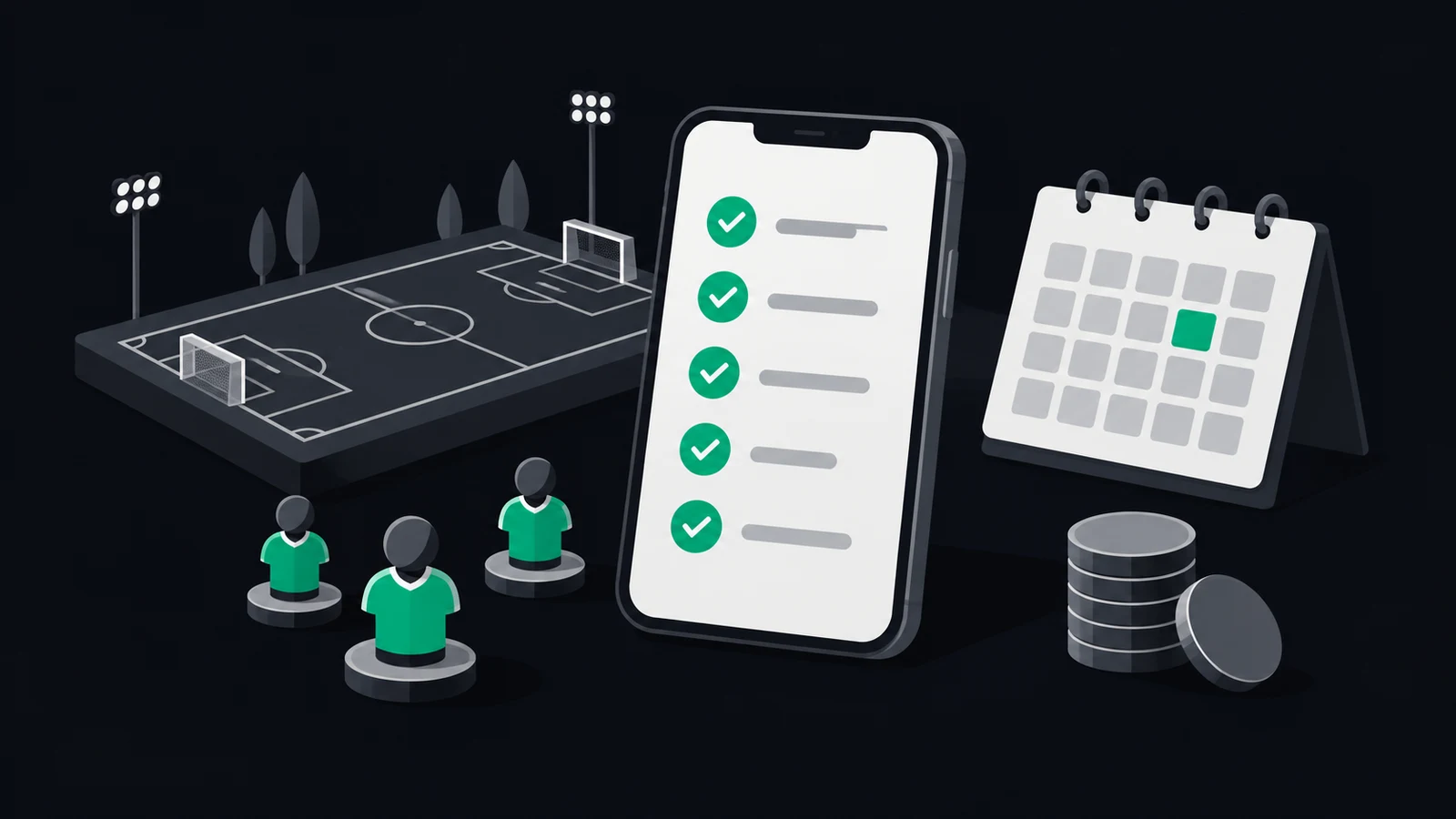
Choose a sports management app by testing attendance, responsibilities and payments against the way your group actually works.
You’re comparing a sports club management app with a tool for organising a weekly football match. Both mention a calendar, players and payments. One also talks about parents, coaching groups and subscriptions.
Another focuses on who is playing on Friday and how much each person owes for the pitch. The feature lists overlap, but the work behind them can be quite different.
I built SpinMyTeam after organising Friday indoor football through a group chat. My recurring jobs were collecting sign-ups, dealing with withdrawals, preparing teams and settling the booking. That experience explains the product’s focus.
It doesn’t mean every sports club should follow the same process. Before choosing software, write down one real week and check whether the app can carry it through without a second attendance list or an unexplained payment balance.
Choose an app for the work your organiser has to finish each week.
Scope → Rehearse → Review
1. Define what you need to manage
“Scope” means describing your organisation before looking at modules. A regular group of adults sharing a pitch may need one match roster. A club may need several teams, coaches and relationships between participants and their guardians.
Neither description tells you which product is best. It tells you which questions to ask during a demonstration. Avoid treating the longest feature list as a substitute for those answers.
Questions for two different organising situations
| Area | Weekly adult football group | Club or academy |
|---|---|---|
| Attendance | Who has a place in this match? | Who attends each training group? |
| Responsibilities | Who can organise and edit the match? | What can coaches, office staff and guardians do? |
| Money | Who owes a share of this booking? | Which membership fees or subscriptions are due? |
| Sporting records | Teams and results for a match | Records needed across teams and activities |
This is a needs checklist, not a claim that every club or app works identically. Keep only the rows that describe your situation and add specific requirements you already handle manually.
If your main job is filling one weekly booking, start with the practical guide to organising a football match. It gives you a process to test before you compare screens.
Describe your group’s actual responsibilities before comparing product features.
2. Rehearse one complete match rather than a tour of screens
“Rehearse” means running an ordinary event from start to finish. Use made-up names for a first trial. Set a capacity, invite participants and see how clearly they can tell whether they have a confirmed place.
Then introduce a change. Let one person withdraw after the match fills up. The useful question is what happens to the next person waiting and what the organiser still needs to do.
A practical trial for an organising app
- Create a match with a clear player limit
- Invite more people than there are places
- Check how confirmed and waiting players are shown
- Withdraw a confirmed player and inspect the next place
- Change the venue or start time and check the participant view
- Record the result and close the pitch cost
This trial is a proposal for evaluation, not a measured performance result. Record where you needed to return to a chat, spreadsheet or personal note. Some extra communication is normal; an unresolved second roster deserves closer attention.
Ask another player to try the participant side from their own phone. An administrator may understand a status label that a new member reads differently. Let the person explain whether they believe they should attend.
Test a complete event and the first change that disrupts it.
3. Check what the payment status actually means
Return to “Scope” when a product says it handles payments. Recording a debt, recording that a transfer arrived and collecting money through a payment provider are different tasks. Your trial should make the distinction visible.
Use a simple worked example. A fictional pitch booking costs PLN 240 and twelve people share it equally.
Each owes PLN 20, and the shares total PLN 240. You can check the result before introducing discounts or late withdrawals.
Illustrative pitch bill used for an app trial
| Item | Amount |
|---|---|
| Booking cost | PLN 240 |
| Participants | 12 |
| Share per participant | PLN 20 |
| Total of twelve shares | PLN 240 |
Now mark one person as paid and inspect the outstanding balance. Eleven unpaid shares of PLN 20 should leave PLN 220. Confirm who may change that status and whether you can understand the history afterwards.
SpinMyTeam records match settlements and payment statuses. Don’t describe those records as proof that an in-app bank transfer or card payment has been processed. The status should reflect the payment you have actually verified.
Read more about splitting the pitch bill before designing a more complicated trial. The rules for who owes money should be clear before software calculates the shares.
Check whether the app records money owed, records receipt or actually collects payment.
4. Test permissions with someone who should have less access
The “Rehearse” stage needs at least two perspectives. Set up an organiser and an ordinary participant. Check whether each can complete their own tasks and whether the participant sees information intended for them.
For a club, add the actual roles you need to evaluate. Don’t assume that a role labelled “member” covers a guardian responsible for more than one child. Ask the product to demonstrate that relationship if it matters to your club.
For a weekly football group, a shorter set of questions may be enough:
Access questions for an amateur football group
- Who can invite or remove members?
- Who can edit a scheduled match?
- Who can prepare and approve teams?
- What can a player see about their own settlement?
- Who can correct a payment status?
In SpinMyTeam, roles belong to each group. Administrators, moderators and players have different responsibilities. Use the trial to check the actions you need rather than assuming everyone with a login can edit everything.
Player ratings used to prepare line-ups are also different from the approved composition shared with players. Seeing who is on your team does not require a public list of everybody’s individual rating.
Check access by performing the task with the relevant account.
5. Review the first week before moving the whole group
“Review” means asking whether the trial finished the jobs you scoped. Start with one match and a small set of participants. Keep the agreed attendance location clear so nobody has to guess which list counts.
Here is an invented message for introducing that trial:
We’re trying the new sign-up list for this Friday’s match. Please confirm your place there; chat messages are for questions. After the match we’ll check whether sign-ups and the pitch bill were easier to follow.
Count the unresolved tasks rather than relying on a general impression. Did the organiser maintain two rosters?
Did waiting players know their status? Could each person understand their own share after the match?
For a recurring amateur football group, SpinMyTeam brings registrations, waiting lists, team preparation and match settlements into one workflow. If your club needs academy administration or guardian accounts, verify those requirements separately before choosing it.
Ask participants what confused them, then repeat the relevant action. A missed label may need an explanation; a missing capability may require another tool. Those are different findings and should lead to different decisions.
Choose after a real trial that finishes your group’s weekly work.
Sports club management app decisions to make first
- Write down the responsibilities your app must cover
- Skip modules that solve none of your current tasks
- Review unresolved attendance, access and payment questions after the trial
Which job currently takes most of your organising time: attendance, team selection or collecting the pitch money?